The safety of laboratory diagnosticians is our shared priority. The laboratory diagnosticians’ self-government is actively involved in countering aggression against medical staff
Aggression against people working in medical professions requires a firm response and effective legal and organisational solutions. The National Chamber of Laboratory Diagnosticians consistently works to improve the safety of laboratory diagnosticians, both by representing the profession in talks with public authorities and by taking part in work on systemic solutions.
Guidelines of the Prosecutor General – a firm response to aggression
On 14 July 2025 the Prosecutor General issued guidelines on conducting proceedings for offences committed against persons providing health services, first aid and emergency services.
The document stresses the need for a firm response to violence against medical staff, for efficient proceedings and for proper protection of victims.
The guidelines pay particular attention to the need for law enforcement to act without delay, to secure evidence effectively and to use the available legal instruments to hold perpetrators accountable.
This is an important signal that aggression against people in medical professions cannot be treated as an inevitable part of their daily work.
KIDL works for the safety of laboratory diagnosticians
The National Chamber of Laboratory Diagnosticians continues to stress the need to ensure adequate legal protection for laboratory diagnosticians and medical laboratory staff.
The President of the National Council of Laboratory Diagnosticians, Monika Pintal-Ślimak, MD, PhD, has repeatedly emphasised the need to take the specific nature of laboratory diagnosticians’ work into account in solutions concerning the safety of medical staff.
The President of KRDL has consistently presented these demands, among others, during parliamentary work and in talks with the leadership of the Ministry of Health in August.
Safety in healthcare should cover all medical professionals, regardless of where and how they work. Laboratory diagnostics is an integral part of providing health services, and the people who perform it should have safe working conditions.
President of KRDL in the Ministry of Justice team
An important element of the efforts to improve the safety of medical staff was the appointment by the Minister of Justice of the Team for systemic measures to strengthen the safety of persons practising a medical profession.
The Team was established by the order of the Minister of Justice of 18 September 2025 (Official Journal of the Minister of Justice, item 180, as amended), issued under Article 7(4)(5) of the Act of 8 August 1996 on the Council of Ministers. It acts as an auxiliary body to the Minister of Justice, and its first meeting took place on 17 November 2025.
The aim of the Team is to develop comprehensive solutions to counter aggression against people in medical professions and to improve safety in places where health services are provided.
The Team’s most important tasks include:
- preparing proposals for legislative changes to strengthen the protection of medical staff,
- monitoring aggression against people in medical professions,
- developing standards of conduct towards aggressive patients,
- developing security standards for places where health services are provided,
- preparing proposals for training in patient communication, de-escalation of aggression, recognising threats and responding to violence,
- improving cooperation and communication between healthcare facilities and law enforcement,
- initiating educational activities and social campaigns against violence towards medical staff.
A particularly important event for laboratory diagnosticians was the order of the Minister of Justice of 13 January 2026 (Official Journal of the Minister of Justice, item 4), under which the National Chamber of Laboratory Diagnosticians was formally included among the institutions represented in the Team.
At the meeting on 22 January 2026, the President of the National Council of Laboratory Diagnosticians, Monika Pintal-Ślimak, MD, PhD, was appointed to the Team.
The participation of the President of KRDL in the Team’s work ensures that laboratory diagnosticians are represented in the discussion on solutions to counter aggression and improve the safety of people in medical professions.
The January meeting discussed, among other things, a draft form for reporting cases of aggression against medical staff, how to make it widely available and the possibility of a pilot. The work also covered standards of conduct towards aggressive patients, de-escalation techniques and security standards in places where health services are provided.
Having a representative of the laboratory diagnosticians’ self-government in the Team is particularly important for taking into account the specific nature of medical laboratories and the needs and experience of our profession in the systemic solutions being prepared.
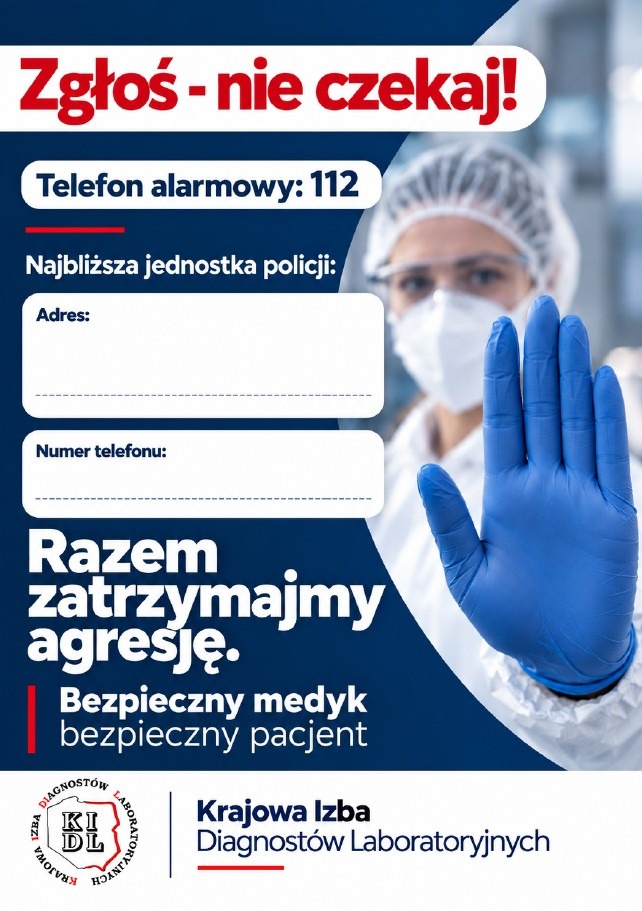
Report it – don’t wait! Together let’s stop aggression
Effective prevention of aggression requires not only the right regulations and procedures, but also a response to every disturbing incident.
The National Chamber of Laboratory Diagnosticians encourages laboratory diagnosticians to report cases of violence, threats and other behaviour that endangers their safety at work.
Aggression should not be downplayed or treated as a natural risk of working in healthcare.
If there is an immediate threat to life or health, call the emergency number 112 straight away.
Information about cases of aggression can also be sent to the National Chamber of Laboratory Diagnosticians at:
zgloszenia.agresja@kidl.org.pl
Reports help the self-government to better understand the scale of the problem, identify threats and take further action to improve safety in our profession.
Download the poster and help build a safe working environment
As part of its efforts to counter aggression, the National Chamber of Laboratory Diagnosticians has prepared an information poster „Report it – don’t wait! Together let’s stop aggression” (in Polish).
We encourage you to download the poster, print it and display it in a visible place in your medical laboratory, collection point or any other place where health services are provided.
A safe diagnostician means a safe patient
The safety of people in medical professions is one of the basic conditions for a well-functioning healthcare system.
The National Chamber of Laboratory Diagnosticians will continue to push for solutions that strengthen the legal protection of laboratory diagnosticians, support initiatives against aggression and take part in the dialogue with the institutions responsible for the safety of medical staff.
Every laboratory diagnostician has the right to work in conditions that respect their dignity, health and safety.
Together let’s stop aggression.
More information:
1. Order of the Minister of Justice on the appointment of the Team for the safety of persons practising medical professions
Order of the Minister of Justice of 17 September 2025 (Official Journal of the Minister of Justice of 2025, item 180), which is the basis for appointing the Team for systemic measures to strengthen the safety of persons practising a medical profession. The document sets out the organisation and tasks of the Team and the rules of its operation.
https://www.gov.pl/web/sprawiedliwosc/du-25-180
2. Order of the Minister of Justice of 13 January 2026 – change in the composition of the Team
Order of the Minister of Justice of 13 January 2026 (Official Journal of the Minister of Justice of 2026, item 4) amending the earlier provisions on the Team, including its composition. The document is the basis for formally including the National Chamber of Laboratory Diagnosticians in the work of the Team.
https://www.gov.pl/web/sprawiedliwosc/du-26-004
3. „A safe medic means a safe patient” – Ministry of Justice information on the progress of the Team’s work
Statement of the Ministry of Justice of 23 January 2026 presenting the course and direction of the Team’s work, including reporting cases of aggression, developing standards of conduct towards aggressive patients and improving safety in healthcare facilities.
